Today, I would like not just to make a post but to invite a discussion on the topic of book adaptations. However, I will focus only on the adaptations of one specific series: The Adventures of Erast Fandorin by Boris Akunin.
Boris Akunin is one of my favorite authors. I have not read all of his works, nor do I enjoy all of them equally. However, the Erast Fandorin series is, in my humble opinion, the best he has written. Today, I will not discuss which novels I like more or less. Instead, I will share my thoughts on the three existing adaptations.
It all began with the film (and later mini-series) Azazel, an adaptation of the very first novel in the series. In fact, I watched the film before I started reading Akunin’s books. At the time, everyone around me was talking about this new and trendy writer, Boris Akunin, and I dislike following trends just because they are popular. But I really enjoyed the film, and almost immediately after watching it, I read the book and became completely immersed in the series, devouring one novel after another.
The series currently consists of 15 books, plus an additional one about Masa, a Japanese servant and partner of Erast Fandorin. Adaptations have been made of the first novel (Azazel, or The Winter Queen in English translation), the second (Turkish Gambit), and, somewhat surprisingly, the sixth (The State Counsellor).
The first film closely follows the book, so for those who have read it, there will be no surprises. However, it is excellently made and still interesting to watch. In Turkish Gambit, with the help of Boris Akunin himself, the screenplay was made slightly different from the book, and the main villain is a completely different character than in the novel (this was done specifically to maintain intrigue). The State Counsellor is also fairly close to the original, although the role of Prince Pozharsky, played by Nikita Mikhalkov, was significantly expanded. All three adaptations, in fact, appealed to me, though each has its own strengths and weaknesses.
If you have not read the books about Erast Fandorin, here is a brief introduction to who he is. Erast is a young (initially) man from an ancient noble family that is not wealthy (Akunin elaborates on the family’s arrival in Russia in another series, formally dedicated to Erast Petrovich’s grandson). As a young man, Erast begins working for the police force, and thanks to his passion and abilities, he quickly climbs the career ladder, eventually becoming a kind of Russian Sherlock Holmes. By the end of the series, he is a seasoned, highly intelligent, and insightful man with his own code of honor. But most importantly, he is an exceptional detective.

In the first film, Erast Fandorin was played by Ilya Noskov, who was 25 years old at the time of the film’s release. In my opinion, it was a perfect casting choice. A young man with a fiery gaze, still unacquainted with the failures and cruelties of the world, but immediately thrust into a series of murders and an international conspiracy, taken “under the wing” of one of Russia’s best detectives, and absorbing his mentor’s habits and deductive method at lightning speed… Noskov managed to portray his character brilliantly.
Fandorin’s genius superior was played by Sergey Bezrukov, and although Bezrukov is often criticized nowadays for “playing in everything and everywhere”—and I am not overly impressed with some of his roles—here, he was also a perfect match for the character from the book.
The film maintains intrigue and conveys the atmosphere of the era quite well. Even if there are some historical inaccuracies, they are not particularly significant here, as this is a work of fiction, not a documentary. It is clear, however, that this is just the beginning of a long journey for the still-young man, who will soon come to understand the meaning of tragedy.
A special mention should go to the actor who played one of the supporting roles—Count Zurov—magnificently portrayed by Sergey Chonishvili. In the book, and even in the film, he is not a central character, but every time Chonishvili appears on screen, it is pure brilliance! I even rewatched several of his scenes multiple times, so wonderfully does he bring to life the character of a young jokester who is far more complex than he initially seems.

In the second film, Turkish Gambit, the entire cast was replaced. The events take place in the Balkans during the Russo-Turkish War. Erast Fandorin has already experienced his first life tragedy, which left his temples prematurely gray and caused him to develop a slight stammer (as seen at the end of Azazel). Although he is still very young, he is no longer the wide-eyed youth he once was but rather a more serious young professional, albeit one still prone to some adventurous tendencies. Yegor Beroev handled this role just as brilliantly.
While Akunin slightly altered the detective storyline (as I mentioned earlier), the main characters remained intact, and the casting was excellent. Olga Krasko did a fine job portraying the enthusiastic young woman who ventures to the warfront to join her hapless fiancé. That fiancé (a relatively small role overall) was played by the then-largely-unknown Alexander Oleshko. Gosha Kutsenko perfectly embodied the Turkish Ismail Bey, Alexander Lykov delivered a fantastic performance as the adjutant Perepelkin… the list goes on, as this film features an ensemble of outstanding actors, including the foreign talents of Daniel Olbrychski and Didier Bienaimé. Bienaimé’s portrayal of the French journalist Charles d’Evreux in this film was his last, as he sadly passed away shortly after filming.
One of the few things I did not like about this film was Dmitry Pevtsov’s portrayal of Count Zurov, a role previously played by Sergey Chonishvili in the first film. Perhaps this dissatisfaction stems from comparing the two portrayals. Pevtsov attempts to depict Zurov as a dandy, a playboy, a joker, and the life of the party, but here it feels forced. In contrast, Chonishvili lived this role, imbuing it with many nuances and shades that Pevtsov failed to capture.
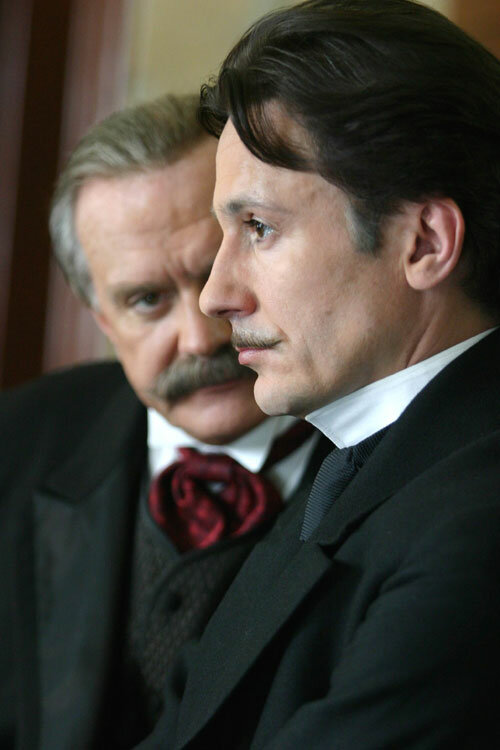
And finally, the third adaptation — The State Counsellor. As I mentioned earlier, this film significantly expanded the storyline of Prince Pozharsky, portrayed by Nikita Mikhalkov, presumably to give Mikhalkov a chance to showcase himself. This expansion, to some extent, benefited the film. Mikhalkov managed to present his character in a very compelling way—a truly strong and controversial figure with his own principles and ideals. In fact, the character became broader and more impactful than in the book. However, this also led to the diminished presence of Fandorin himself, who was played in this adaptation by Oleg Menshikov.
In the story, Fandorin is no longer a young man. He is a seasoned figure with a well-earned reputation and trust built on his accomplishments. He has worked in the Russian Embassy in Japan and now holds the rank of State Counsellor, serving under Prince Dolgorutzky, the governor of Moscow. He is a savvy veteran, aware of his worth, facing a formidable opponent while being forced to work with a superior sent from the capital whose methods he does not entirely approve of, though he occasionally finds them effective. Oleg Menshikov is a very fitting choice for the role of Erast Petrovich at this stage in his life. However, he was overshadowed by Mikhalkov, who did not allow the character to fully unfold, despite Menshikov being an excellent actor. In my opinion, he was constrained by the script. Meanwhile, many supporting actors delivered outstanding performances once again. Konstantin Khabensky as the lifeless Grin, Oksana Fandera as the equally cold and ideological revolutionary Needle, and Maria Mironova as the capricious and cheerful Julie all fit their roles perfectly.
All three films are very different, but each is an excellent adaptation of the original work. I cannot call any of them a failure. They have their flaws, but none of them are unsuccessful. At the same time, I find it very difficult to compare them. After much thought, I decided to place Turkish Gambit first—it is the most cohesive, with the unforgettable songs “Idyom na Vostok!” (“Heading East!”) and “Dozhdik osenniy” (“Autumn Rain”) as part of the soundtrack. Azazel earns a well-deserved second place. And third, I would place The State Counsellor, primarily because Fandorin himself takes a back seat in this adaptation.
By the way, I am still waiting for the Hollywood adaptation of the first novel, which has been in development for several years but remains uncertain if it will ever see the light of day.
In conclusion, I would first like to recommend watching all three films if you have not seen them for some reason, as well as reading the Fandorin series itself (all of them have been translated to English). Secondly, I would love to hear your thoughts: which adaptations of your favorite books do you consider successful? People often write much more about unsuccessful adaptations, so that is less interesting (for me, one of the top failures is Ender’s Game, though I cannot imagine how such a psychological novel could be adapted at all).


